Your product pages finally visible in Google
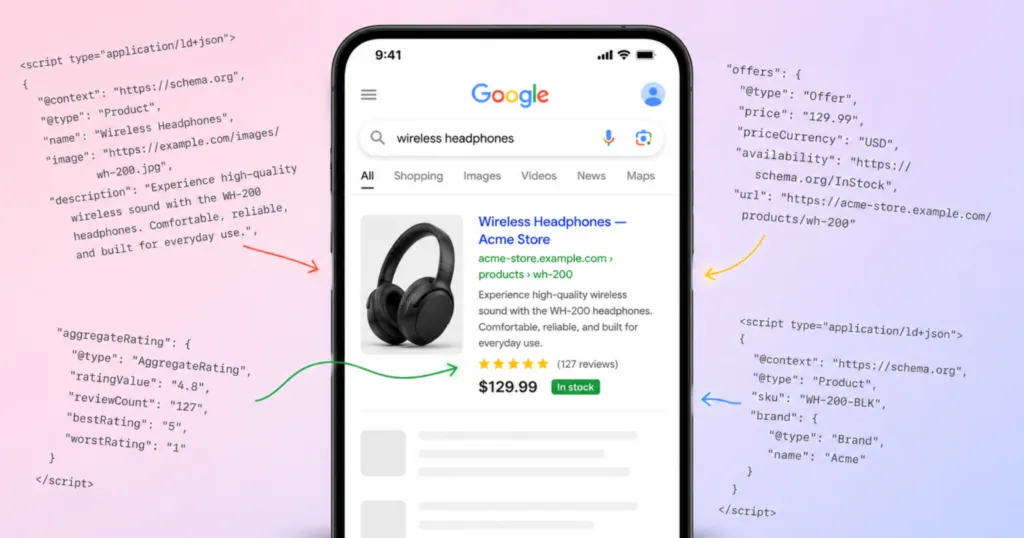
Free update for TOWeb 14 users. Your product pages automatically become Google rich snippets (stars, price, stock) at the next publish, no configuration required.
The problem you can't see
Run a test right now. Type the name of one of your products in Google. If you're on the first page, look at what your competitors display:
- Review stars under their link
- Price shown directly in the SERP
- "In stock" or "Available" in green
- A small product thumbnail next to the title
What about your own listing? Probably just a blue link with a grey description. Indistinguishable from the 9 other results on the page.
That's what SEOs call rich snippets. They are the visual enhancements Google displays only when your site speaks to it correctly, in a language called JSON-LD schema.org. If your site stays silent, Google shows only the bare minimum.
TOWeb 14.05 ends this silence, automatically, on every product page of your catalogs. No checkbox, no file to edit. You publish, Google sees.
Why it matters (and is urgent)
According to Google Search Central, a product with a rich snippet attracts on average 15 to 30 % more clicks than one without, at the same SERP position. For an e-commerce site receiving 1,000 monthly visitors from Google, that's 150 to 300 extra free visitors per month. No advertising, no budget, no change to your catalog.
Better: Google now treats rich snippets as a quality signal in its ranking algorithm. A product without structured data is gradually demoted in favor of competitors that have it. The SEO gap widens month after month.
That's why all major e-commerce platforms (Shopify, WooCommerce, PrestaShop, Magento) have been emitting structured data as standard for years. TOWeb joins them in 14.05 — and the catch-up applies retroactively to your entire existing catalog.
How Google "sees" your product pages in 2026
A product page, for a human, is a title, a description, photos, a price, a "Add to cart" button. For Google, it's also an HTML file — but the search engine does not guess that a particular number is a price, that a particular sentence is a description, that a particular image is the main product photo.
The JSON-LD schema.org standard solves this. Concretely, it's a small invisible block in the <head> of every page that explicitly tells Google:
"This page is a product. Its name is 'X'. It costs €49.90. It's in stock. Here's its SKU. Here's its main image. Here's its brand."
Google reads this block, understands it instantly, and activates the rich snippets on your link in the SERP. It's also this same block that Google Merchant Center reads to list you in Google Shopping (an optional next step, outside the scope of this article).
Before TOWeb 14.05: this block didn't exist in the generated pages. Your products were technically invisible to Google.
With TOWeb 14.05: the block is generated automatically on every product page at publish time. No template to choose, no field to fill in.
What TOWeb 14.05 does automatically, page by page
At each publish of a site with a catalog, TOWeb extracts the information you've already entered in your product pages and emits a complete JSON-LD block compliant with schema.org/Product. Here's what is filled in:
| TOWeb 13 or earlier | TOWeb 14.05 |
|---|---|
| No Product structured data | Complete JSON-LD schema.org/Product on every page |
| Blue link + grey description in Google | Stars + price + stock + image in the SERP |
| Not eligible for Google Shopping | Eligible (a Merchant Center setup suffices afterwards) |
| Average e-commerce CTR without rich snippets: 2-3 % | CTR with rich snippets: 3-4 % (source: Google) |
| User effort | Zero — everything is automatic at the next publish |
| TOWeb state | Google display |
|---|---|
| In stock | InStock — shown in green in the SERP |
| Limited stock | LimitedAvailability — shown with urgency |
| 7-day / 7-15 day delay | PreOrder |
| 15+ day / unknown delay | BackOrder — on order |
| Out of stock | OutOfStock — clearly indicated |
Verify in 30 seconds that it works
Once your site is republished with TOWeb 14.05:
- Open the Google Rich Results Test in your browser
- Paste the URL of one of your product pages
- Click Test URL
Expected result: ✅ "Page is eligible for rich results — Product" with a preview of how Google will display the rich snippet in the SERPs.
It's the official Google tool — the same validation used by professional SEOs and by the developers of the major e-commerce platforms. If your page passes this test, you know Google will read it correctly.
The argument nobody calculates
Let's run the numbers on a concrete case. You have a TOWeb catalog of 100 products. According to Google Analytics, your site receives 1,000 Google visitors per month. Average e-commerce conversion rate: 2 %. Average basket: €45.
| Scenario | Google visitors / month | Sales / month | Revenue / month | Revenue / year |
|---|---|---|---|---|
| Without rich snippets (TOWeb 13-) | 1,000 | 20 | €900 | €10,800 |
| With rich snippets (TOWeb 14.05) | 1,200 *(+20 %)* | 24 | €1,080 | €12,960 |
| Difference | +200 | +4 | +€180 | +€2,160 |
Sources: Statista - e-commerce conversion rate 2025 and Google Search Central - Visual Elements Gallery.
Special cases handled automatically
Quote-based product (no fixed price): TOWeb does not emit the offers.price block but the rest of the JSON-LD remains valid. Google displays the snippet without the price, with no error.
Product with variants (size, color): version 14.05 emits the main product. Full variant support (ProductGroup + hasVariant) is planned for V14.06.
Out-of-stock product: OutOfStock is emitted explicitly. Google may then demote your page in e-commerce SERPs — which is actually beneficial for you (visitors land on products you can sell, not on dead ends).
Power user with a manual JSON-LD in the site's custom HEAD: TOWeb detects the existence of an application/ld+json block and does not emit its own, to avoid conflicts. You keep control.
For users still on TOWeb 13 or earlier
If you have an e-commerce catalog and you're on TOWeb 13 (or older), your site emits no Product structured data. Concretely:
- Your product pages are invisible to Google rich snippets
- You are demoted in e-commerce SERPs against competitors who have activated structured data (the majority today)
- You cannot be listed in Google Shopping without complex manual configuration
- You lose 15 to 30 % of potential Google traffic on your products
Upgrading to TOWeb 14 fixes all this automatically, retroactively, across your entire existing catalog. No re-entry, no migration, no file to edit. You install TOWeb 14, you open your existing site, you publish. Google sees the difference within 24 to 72 hours (the time it takes to re-crawl your pages).
For a catalog of more than 50 active products, the upgrade typically pays for itself in under 2 months on the Google traffic gain alone — not counting the other TOWeb 14 features (GDPR-2026 compliant cookie banner, assisted legal documents integration, support for Google Consent Mode v2, automatic privacy page generation, etc.).
How to benefit
You're already on TOWeb 14 (14.00 to 14.04): the upgrade to 14.05 is free. Download the latest version, republish your site, done. Google will see the rich snippets activated within 24-72h.
You're on TOWeb 13 or earlier: Product JSON-LD auto-generation does not exist in your version. It's one of the fastest-paying-back arguments to upgrade to TOWeb 14.
You're new to TOWeb: the Product JSON-LD feature is available on the Pro, Business and Studio editions (the editions that support e-commerce catalogs). It requires no configuration, no plugin, no extra data entry.
In summary
| TOWeb 13 or earlier | TOWeb 14.05 |
|---|---|
| No Product structured data | Complete JSON-LD schema.org/Product on every page |
| Blue link + grey description in Google | Stars + price + stock + image in the SERP |
| Not eligible for Google Shopping | Eligible (a Merchant Center setup suffices afterwards) |
| Average e-commerce CTR without rich snippets: 2-3 % | CTR with rich snippets: 3-4 % (source: Google) |
| User effort | Zero — everything is automatic at the next publish |
Read more
- TOWeb 14.05 — The new WebLegal cookie consent banner — the other V14.05 novelty on the compliance side
- TOWeb 14.05 — Your legal documents generated and integrated in 2 clicks — the end of copy-pasting Terms of Use / Sale
- Google Search Central — Product structured data (Google official reference)
- Schema.org Product (reference standard)
- Google Rich Results Test (validate your site in 30 seconds)
Question, feedback, suggestion? Visit the TOWeb support page.